The Ancestor in the Stillhouse: A Family Genealogist's Guide to Scotland's Whisky Records
Most people who visit a distillery come for the whisky. A smaller number come for the history. And a handful arrive with something more personal in mind: a name scrawled in a family Bible, a photograph of a great-grandfather standing before copper stills, a vague family story about someone who 'worked with whisky' in Scotland before the war. For this last group, a distillery's archive can be something closer to a family archive.
Bladnoch, founded in 1817 on the banks of its eponymous river in Wigtownshire, has been part of Galloway's social fabric for nearly two centuries. That longevity means its history intersects with the lives of a great many families — not only in the immediate region but across Scotland and, through emigration, throughout the wider English-speaking world. Understanding how to approach that history systematically can transform a vague family tradition into something documented and specific.
Why Distillery Records Are Genealogically Rich
The whisky industry generated paperwork in quantities that would have surprised its participants. Excise regulations required meticulous record-keeping from the early nineteenth century onwards: production volumes, still capacities, duty payments, and the names of licensed operators were all subject to official scrutiny. This bureaucratic burden, frustrating to distillers at the time, has proved an unexpected gift to their descendants.
Beyond the regulatory record, distilleries maintained their own internal documentation. Payroll ledgers, apprenticeship agreements, correspondence with maltsters and cooperages, and the personal notebooks of distillery managers all survive in varying degrees of completeness. When combined with the standard genealogical sources — census returns, parish registers, valuation rolls, and statutory birth, marriage, and death records — these materials can produce a remarkably detailed picture of an ancestor's working life.
Beginning Your Research: The Essential Sources
If you suspect a family connection to the Galloway whisky trade, the most productive starting point is the National Records of Scotland in Edinburgh. Their holdings include the records of the Board of Excise and its successors, which document licensed distilling operations across Scotland from the late eighteenth century. Bladnoch appears in these records from its founding, and the names of its successive licensees and managers can often be traced through multiple decades.
The ScotlandsPeople online database provides access to the core civil and church records that establish the basic facts of an ancestor's life. For Galloway specifically, the Dumfries and Galloway Archives in Ewart Library, Dumfries, holds local material that complements the national collections — including estate papers, solicitors' records, and the archives of local businesses that supplied or employed distillery workers.
For the period after 1841, census returns are indispensable. The occupational descriptions used by enumerators were not always consistent, but terms such as 'distiller', 'maltman', 'stillman', 'cooper', and 'exciseman' appear with sufficient regularity to make systematic searching worthwhile. Cross-referencing an ancestor's listed occupation with their place of residence can confirm a connection to a specific operation.
The Coopering Connection
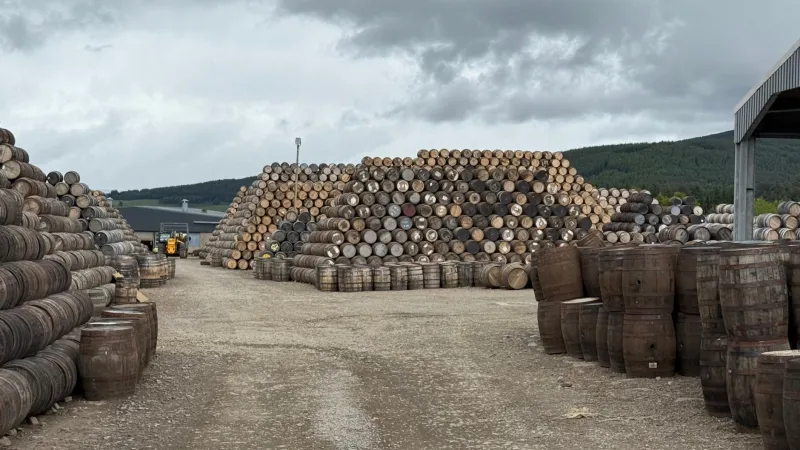
One frequently overlooked avenue of research involves the coopering trade. Distilleries did not employ coopers directly in all periods; many relied on independent craftsmen who moved between clients across a region. If an ancestor is recorded as a cooper in Wigtownshire or the surrounding counties during the nineteenth or early twentieth centuries, a connection to Bladnoch — or to the wider network of casks and barrels that supported it — is plausible and worth pursuing.
The records of the Coopers' Company and equivalent craft organisations, where they survive, can document individual craftsmen's careers. Local newspapers, digitised through resources such as the British Newspaper Archive, frequently carried notices of apprenticeships, retirements, and the deaths of tradespeople, often with biographical detail that supplements the official record.
Reading the Landscape of Work
Genealogical research in the whisky industry benefits from an understanding of how distilleries were organised. A nineteenth-century operation like Bladnoch employed a relatively small permanent workforce — a manager or distillery owner, a handful of stillmen, maltsters who prepared the barley, and general labourers during the busiest periods of production. Seasonal and casual workers were common, which means that a family connection might appear in records only intermittently.
The exciseman deserves particular mention. The government officer responsible for monitoring a distillery's output was a fixture of the industry, often resident in or near the distillery itself. Excisemen were frequently transferred between postings, which means that an ancestor in this role might appear in records across multiple Scottish counties. Their careers are documented in Treasury and Customs and Excise records held at the National Archives in Kew, making them among the more traceable figures in distillery history.
Approaching Bladnoch's Own Archive
Blaднoch's history encompasses periods of continuous production, closure, and revival — a pattern common to many smaller Scottish distilleries. Each transition left documentary traces, and the distillery's current custodians are conscious of their responsibility to that accumulated record. Researchers with specific enquiries relating to family connections are encouraged to make contact through the distillery directly; while the archive is not a public research facility, genuine genealogical enquiries are treated with the seriousness they deserve.
Visiting the distillery in person adds a dimension that no document can fully replicate. Walking the site where an ancestor spent their working days — even if the buildings have changed substantially — connects the abstract facts of a genealogical record to a physical reality. The River Bladnoch, the Galloway light, the particular smell of a working stillhouse: these are continuities that two centuries have not entirely erased.
The Record Behind the Dram
Every bottle of Bladnoch represents not only the labour of its current team but the accumulated knowledge of everyone who worked at the distillery across its long history. For families with roots in the Galloway whisky trade, that continuity carries a personal dimension. The records are there, if you know where to look. The story they tell may be more detailed — and more rewarding — than you expect.